

Client Profile
The client is an IT consultancy based in Abu Dhabi, UAE, with approximately 40 employees. Its core operational workflow involved converting complex civil drawing PDFs into simplified CAD files. The engagement focused on AI-driven automation to double drawing-processing capacity and support more projects without increasing headcount.
Business Challenge
Despite partial automation through LISP tools in AutoCAD, the client's drawing conversion workflow remained constrained by semi-automated processes. Its 25-person processing team was limited to two drawings per day, restricting capacity to take on additional projects. Five interconnected challenges defined the problem.
- Output Capped by Semi-Automated Processes: Existing LISP-based tools provided partial automation for tasks such as centreline wall creation, arc-to-polyline conversion, and QC checks. However, the overall process still required substantial manual intervention, limiting the team to two drawings per day despite the tools in place.
- High Manual Effort and Error-Prone Conversion: Manual and semi-automated raster-to-vector conversion introduced both inefficiency and risk. Human intervention at each step of the process increased the likelihood of inconsistencies, geometric errors, and rework, all of which added time and cost to an already constrained workflow.
- Inability to Scale Without Adding Headcount: Meeting higher project demand using the existing process would require proportional increases in staffing, raising labor costs and reducing margins. The firm needed a solution that could expand output capacity without expanding the team.
- Competitive Exposure from Faster Competitors: Competitors adopting AI-driven automation could potentially deliver faster turnarounds and more consistent output quality. Without a comparable capability, the client faced the risk of losing project opportunities to rivals with more efficient workflows.
- Scalability Constraints on Larger or More Complex Projects: The existing workflow made larger or more complex civil drawing sets difficult to process efficiently. Scaling up would have increased manual effort, reinforcing the need for a different approach.
Scope of Engagement
ICW delivered a complete AI-enhanced PDF-to-CAD automation framework on a project-based engagement, executed by a dedicated team of one project manager and three specialist developers. The scope covered end-to-end solution delivery: AI model development and training for architectural element recognition, custom AutoCAD API scripting for automated DWG creation and modification, APS integration for format conversion, post-processing optimization to minimize residual manual effort, and a comprehensive handover including staff training and technical documentation. The engagement followed a structured agile delivery model with milestone-based client reviews at each phase.
Tools & Methods Used
The engagement drew on a purpose-built technology stack combining computer vision, machine learning, and CAD automation tooling, selected specifically to address the client's PDF-to-CAD conversion bottleneck and deliver a production-ready, scalable solution.
- OpenCV AI-based image processing to detect and extract lines, symbols, and architectural elements from scanned PDF civil drawings
- ML Models Custom-trained machine learning models for drawing recognition, element classification, and intelligent vectorization of raster content
- APS APIs Autodesk Platform Services APIs for automated DWG file creation, modification, and format conversion within the production pipeline
- AutoCAD API Custom scripting for post-processing optimization, quality control automation, and workflow integration within the client's existing CAD environment
- Visual Studio Development environment used during the CAD automation engagement
- Adobe Acrobat PDF software included in the project's technology stack
- Agile Delivery Phased, iterative implementation with milestone-based client reviews at each stage: requirement analysis, AI development, scripting, testing, deployment, and training
Execution Process
The project followed five defined delivery stages with regular client reviews and milestone approvals.
-
Phase 1: Scope Analysis and Requirement Gathering
The team conducted detailed scoping discussions with the client to document current workflows, identify specific pain points, and define the functional requirements for the automation solution. Sample drawings, existing LISP tools, and process guidelines were gathered to inform AI model design and establish baseline performance benchmarks for the conversion workflow.
-
Phase 2: AI Model Development and Training
Machine learning models and computer vision algorithms were developed and trained using OpenCV and custom AI tooling to detect and extract architectural elements from PDF drawings, including walls, doors, columns, and windows. Iterative training cycles were conducted against client-provided drawing samples to optimize recognition accuracy and ensure the models performed reliably across the range of drawing complexity the client's team encountered in production.
-
Phase 3: CAD Automation Script Development and APS Integration
Custom automation scripts were developed using AutoCAD APIs to handle vectorization, geometry creation, layer assignment, and drawing output, with Autodesk Platform Services APIs integrated to manage automated DWG file creation, modification, and format conversion. The integration layer was designed to fit into the client's existing AutoCAD workflow.
-
Phase 4: Testing, Quality Assurance, and Optimization
Rigorous testing was conducted against client-provided test cases and production drawing samples to validate accuracy, processing speed, and output consistency across drawing types and complexity levels. Issues identified during testing were resolved iteratively, with each optimization cycle verified against the client's acceptance criteria before the solution was advanced to deployment.
-
Phase 5: Deployment, Training, and Handover
The validated solution was deployed to the client's production environment with minimal disruption to ongoing operations. Comprehensive hands-on training sessions and live demonstrations were delivered to guide the client's team through the new automated workflow. Structured knowledge transfer sessions covered technical maintenance procedures and best practices, supported by detailed documentation and a post-deployment feedback loop to address any operational queries during the transition period.
Process Integrity and Quality Assurance
Delivering a production-ready AI automation solution required not only technical precision but a process the client's team could adopt, maintain, and build on after handover. ICW structured the engagement to meet that standard at every stage.
- Regular milestone-based client reviews and approvals supported alignment on scope, direction, and delivery quality throughout the engagement.
- Rigorous testing protocols were applied at each stage using client-provided drawing samples and defined acceptance criteria, validating accuracy, efficiency, and reliability before the solution advanced to the next phase.
- Client feedback and requested changes were handled through documented communication, milestone-based reviews, and approvals.
- Staff training was delivered through hands-on sessions and live demonstrations rather than documentation alone, ensuring practical adoption and reducing the risk of post-deployment workflow disruption.
- A post-deployment support and feedback loop was maintained to capture operational queries, troubleshoot edge cases, and refine the solution during the critical transition period before full handover.
Results & Outcomes
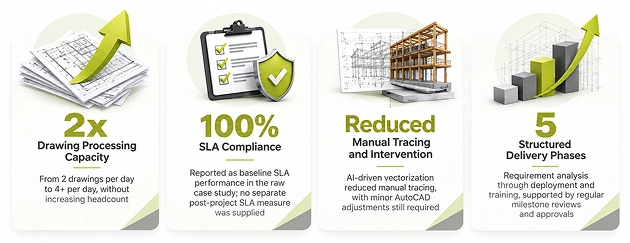
The raw case study reports doubled drawing-processing output, reduced manual effort, and a five-phase delivery approach. The 100% SLA figure is a baseline measure rather than a separately documented post-project improvement.
Conclusion
By combining computer vision, custom AutoCAD scripting, and APS API integration within a phased delivery, ICW supported the reported doubling of drawing-processing capacity while reducing manual effort. Training, documentation, and post-deployment support helped the client adopt the workflow. The engagement demonstrates ICW's ability to address CAD conversion bottlenecks through engineering automation rather than additional manual processing.
Why ICW?
This engagement demonstrates ICW's capabilities in CAD automation, AI-assisted drawing recognition, and implementation support. The project included:
- A project team of one project manager and three developers working with AutoCAD, APS APIs, OpenCV, and ML-based automation
- Deep expertise in PDF-to-CAD conversion, vectorization, and AI-driven drawing recognition workflows
- A project-based engagement with milestone reviews and staff training
-
Start with a Free Trial?
- Contact Form
- Live Chat
- Email Us
- 855-259-3709